
Even within the world of Twin Peaks, Harold is abnormal. He is an agoraphobic recluse whose life revolves around tending orchids and collecting other people’s stories. In this first of a series of posts on lodge spirits, I shall make the case for Harold being if not a lodge spirit then someone attuned to and highly influenced by the spirit world.
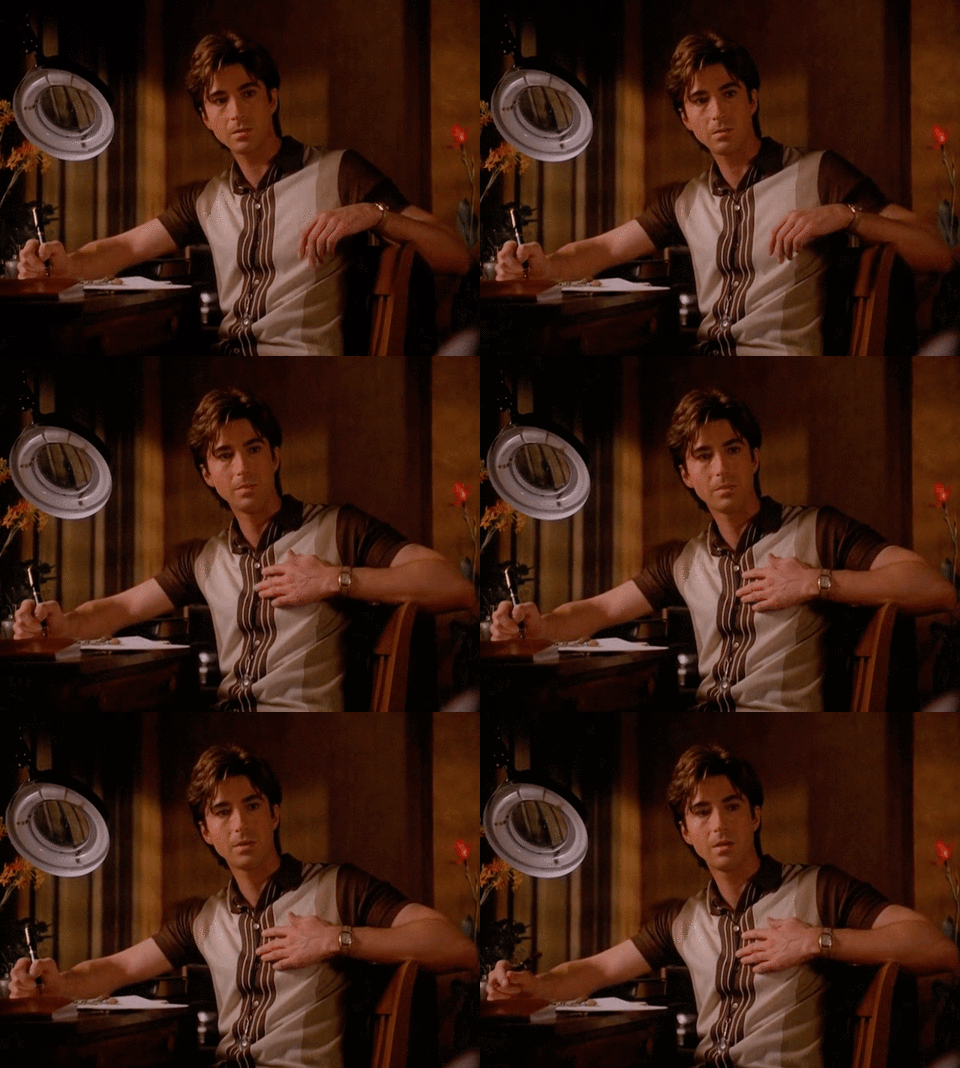
[GIF description: Harold taking down Donna’s story]
We are introduced to Harold through Donna’s detective work, researching those that Laura formed bonds with on her Meals on Wheels tours. Harold is one of the few characters to be almost totally isolated within Twin Peaks, and thus the parallels we can draw with other characters are few. The only people with whom he seems to have a parallelism are the Tremonds/Chalfonts, the seeming inhabitants of the other house that viewers will remember Donna visiting on her investigations. Their existence is later denied by the real inhabitant of the house, and through Fire Walk With Me and the third series we get significant evidence to suggest that the Tremonds/Chalfonts are in fact spirits from the Lodge who were communicating with Laura prior to her death. Were there a more diverse cast of Meals on Wheels recipients, we would perhaps see Harold in a different light, but it is significant that these spirits are our only point of reference for him and the only characters with whom he has a narrative parallel. Thus, already, we may expect something of the ethereal.
Harold’s agoraphobia is also suggestive of a spirit; when Donna makes him leave the house, he collapses. (Interestingly, he looks at the sky with fear, perhaps a manifestation of agoraphobia but equally possibly a fear of the woodsmen.) This sort of behaviour is the reverse of that of vampires and is reminiscent of fairy forts. It is worth mentioning here that I am European – I don’t know enough about if this sort of behaviour is also common to Native American mythology, which saturates Twin Peaks. The frame of his front door seems to be made out of two trunks of wood, reminding me visually of Glastonbury Grove, like a spiritual gateway (my post about wood and spirits can be found HERE) [link opens in new tab]. The implication is that Harold’s home is some halfway house between the mortal and immortal world, and that he cannot cross over into the fully mortal realm.

Harold possesses Laura’s secret secret diary, which proves to be one of the final clues in solving the mystery of who killed Laura. Throughout the series, it is clear that there are spirits trying to aid Cooper and co. in solving Laura’s murder, whether it be through guiding Coop’s rocks in the Tibet scene, the words of the Fireman/Giant or the one-armed man trying to wake Dale from his dormant state. This is something which in Fire Walk With Me and the third series ties into diaries, as Annie leaves a message with Laura from her future in the Lodge telling her to write that the good Dale is trapped in the Lodge, and with the help of Margaret’s log Hawk finally discovers these pages more than twenty-five years later, when he needs to. Such a serendipitous discovery of Laura’s second diary in series two should therefore be treated cautiously, and not brushed over as coincidence. Laura asked Harold to keep it for her – we don’t know why, but we do know that Harold obeys this instruction religiously, not even letting Donna read the words within the diary but instead reading them to her, and of course keeping the diary hidden in a secret cupboard. Regardless of his relationship with Donna, either romantically or in terms of her story, Harold’s primary objective seems to be to keep the diary safe. And yet, despite this, he makes sure that Donna knows about it; he wants it to be discovered, but by the right person at the right time. It seems logically sound to assume that it was Harold who sent the letter suggesting looking into Meals on Wheels – he can’t leave his house, after all, and it ties in with his attempts to direct Coop to the diary.

[Donna and Harold holding hands over a flower]
When Donna first finds the second diary, we hear a slowed-down, creepier version of Laura’s theme, the same as that of the picnic where we hear Laura say “help me”. The echo feels deliberate here. Now that series three has been released, we understand (or pretend to) that timelines are not straightforward, and that they can be rewritten. Having met Carrie Paige and seen the alternate timelines of Judy, we can also surmise that the life and death of Laura Palmer is not as simple as it was made out to be in the pilot. Just as we hear Laura’s “help me” at the picnic, so too in series three does Gordon Cole for a second see a vision of Laura screaming, bleeding through into our world. Here we have the suggestion that the search for Laura’s murderer is not one-sided, and that Laura herself is in some way trapped in time and pain, trying to get out. We also know from her work with Annie and the diary in Fire Walk With Me that Laura was not beyond leaving clues to help others to solve her mystery, even if she didn’t understand why. With that in mind, I suggest – perhaps tenuously – that the music echoed here suggests a similar cry for help from Laura, attempting to push through the veil of time to reach Dale and help herself through leaving this diary.
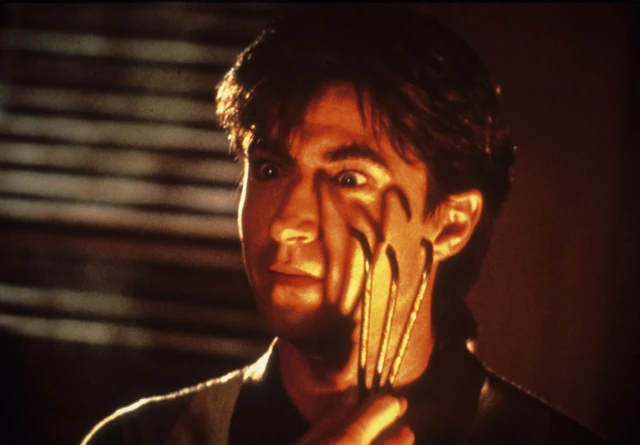
[Image description: Harold putting the fork to his face]
More tenuous than even that is the paragraph that follows, but I believe that nothing is too strange for Twin Peaks! Harold tells Donna and Maddy that the greatest secret of all is knowing the secret of who killed you, which is a bizarre comment to make; although it sounds profound, it doesn’t seem to mean very much at all. The usual interpretation, I imagine, is that this is foreshadowing of Harold’s own suicide, an interpretation which is backed up by his act of self-harm as he says the line. However, I’m going to posit an alternative explanation. The big question of Twin Peaks – before all the weird stuff kicked in, the question that everybody who was around in the 1990s knows – is who killed Laura Palmer? Harold is obsessed with people’s stories, and in much the same way as the viewer watching the whodunnit he seems to need closure on Laura’s story. Yet of all the unfinished stories in his cupboard, Laura’s seems to take disproportionate precedence (over Donna’s, for example), and furthermore, “knowing who killed you” seems specific and personal rather than general, as seen in the theory where it foreshadows his suicide. Is Harold, then, working for Laura in some form, helping her to find closure on her own story rather than be stuck screaming in alternate timelines or lodges? I suggest that Harold, as much as the planted diary, is a part of Laura’s attempt to save herself. It is Harold, after all, who carries the pages of Laura’s diary, suggesting some form of shared consciousness (or a pun stretched too far). In Part 8 we have seen Laura as an orb of good energy, unleashed on the world to counterbalance BOB – I don’t believe it unreasonable to assume that this energy can transcend the boundaries of life and death in order to save herself and restore order to the universe.








 How's Annie?