Arpeggios are absolutely central to the music of Twin Peaks. Of course, arpeggios are to a degree central to all western music; they are the key notes that every chord is built around. Yet arpeggiated bass seems omnipresent in all of the most important music in Twin Peaks. The theme tune is underlined by a faint arpeggio, which means that not only does it underline the whole show, it also makes its way into Falling by Julee Cruise. It’s even more prominent in Laura Palmer’s theme, where the entire bass is an octave and a half arpeggiating. No Stars by Rebekah Del Rio is classic 6/8 time playing a full arpeggio, which you’ll hear almost identically in Just You and I.
Playing the main notes of a chord is not that interesting. What’s interesting is this constantly repeating theme of doh-mi-soh-doh-soh-mi-doh in a cycle, or doh-mi-soh-doh-mi-doh-soh-mi-doh if it’s Laura Palmer’s theme. The choice of a cyclical musical motif to run through all the main pieces of music of the show is hardly a coincidence in a show which places so much emphasis on time repeating itself. And let’s look where these arpeggios come up.
In this scene, the one at the Roadhouse where Maddy’s death is revealed, Julee Cruise has three songs, the latter two of which sandwich the It is happening again statement by the Giant/Fireman – and both of which are linked by this arpeggio motif. The underlining of a motif of circularity in the music is perfect for realising the parallel murders of Maddy and Laura, as well as the sense that these cycles of violence will go on perpetually if they are not broken. Yet to break them would also break the music, the aesthetic pleasure of Twin Peaks – I cannot help but wonder if Lynch and Frost are deliberately contrasting the beauty of the music with the violence of the music to test his audience, to ask us at what point our relaxed viewing becomes wrong. Remember that Twin Peaks is, at its heart, a show about a town which does nothing as its young women are brutally murdered, a town which is corrupted to the core. Twin Peaks has often been criticised for its aesthetic depiction of violence against women, but I don’t buy into that, largely because Fire Walk With Me, told from Laura’s perspective, is one of the most harrowing films I’ve seen. It pulls no punches when it comes to the subject matter. So when Lynch and Frost choose that Kubrick-esque aestheticisation of pain, particularly in a show which is so self-aware, that is surely a deliberate challenge to the viewer. What does it mean for the chain of violence to be interrupted?
With that in mind, it’s interesting to note that the moment that Dale saves Laura is underscored with Laura’s theme, one which also relies heavily on arpeggios.
This moment, when the cycle of violence should be broken, we instead hear those arpeggios going round and round. In hindsight, this is a sure sign that something is wrong – to save Laura, Dale needs to break the cycle. In Part 17, we are presented with a perfect, all strings tied up ending which simply cannot happen. The violence that has engulfed Twin Peaks cannot be solved so perfectly. And so of course the fact that that cyclical music continues tells us that there is something wrong. When Laura vanishes and the second, more troubling ending begins, that is when the beautiful music ends and our tranquillity is ruptured by Sheryl Lee’s unparalleled scream. If we are to truly break out of the world of aesthetic violence, we have to do so in a way that confronts evil, not that simply pushes it to the side – it has to be uncomfortable and deeply unsettling. That is why the false ending of Part 17 works so well – because it shows people the closure they wanted and then completely undercuts it and exposes its falsity.
Arpeggios are used as a starting point to lead into a much grander thesis about the show there – do leave a comment below and let me know if you agree or disagree!
There is a lot of speculation in the Twin Peaks world about Annie Blackburn and the idea that she may be a tulpa. I am not the first to think of this, nor will I be the last – Annie’s odd behaviour is wonderfully summed up here [link opens in new tab] by Lindsay Stamhuis. To summarise briefly why I think Annie is a tulpa:
1.) In narrative terms, she’s awkward. Introducing a main character to the narrative only a few episodes from the (at the time) end is a really odd thing to do, and it jars with our expectation of television. In the space of a couple of episodes, she and Coop meet, fall for each other, and then she becomes Earle’s bait to lure him to the Lodge. Even for viewers who aren’t trying to analyse, Annie instantly feels like a plot device, and a lazy one at that. This is especially true when you can compare her rapport with Coop to Coop’s with Audrey, which has been slowly burning over two series. Whilst I’m glad that Audrey never became Cooper’s romantic interest, the contrast between the established and nuanced relationship with Audrey and the artificial, too quick and too easy relationship with Annie makes Annie unbelievable. I am nearly always of the belief, however, that Lynch and Frost do everything for a reason, and this seems like a strange blip in the oeuvre of such great storytellers. It follows, for me, that Annie’s presence is supposed to feel unnatural and artificial. Her role as narrative bait to lead Cooper to the Lodge sets her up as an obvious device – the logical reason for this is that that is her character’s purpose. She is a tulpa both in narrative terms and in-universe.
2.) As well as occupying an awkward place in the narrative, Annie is an awkward human being. She doesn’t know how to act in social situations. This is marked up to her being in a convent and not being used to normal human behaviour, but this explanation doesn’t really hold up – Annie still should have had a life before entering the convent, and whilst I imagine convents are different to the “normal” world in atmosphere, they’re still populated by people. Annie almost seems like a child, learning how to behave properly by other people’s behaviour. We can see the most notable example of this here:
She doesn’t seem to know how to respond to questions like “how are you” – things she would know had she been in a convent. Annie’s background seems more mysterious than her cover story. Given the obvious role she plays in luring Cooper to the Lodge, it seems to me logical that she is a tulpa, or manufactured being, whose role is to do so. The reason she is adjusting to “the social niceties” is because she is like a child who is trying to learn the norms of human behaviour.
This theory I’ve put forward above is not new – plenty of people have come to it independently. Populer_lar on Reddit suggests that the name Blackburn is a link to the Black Lodge, which I particularly like, here [link opens in new tab]. However, I want to now argue something a little less common – that Caroline was also a tulpa and that Annie is her tulpa reincarnation.
Caroline and Annie have several things that link them together. Firstly, they are – in the first two series – the only real love interests of Cooper. Secondly, they are both targets of Windom Earle. Thirdly, when Coop follows Annie and Earle into the Lodge at the end of series 2, Annie keeps morphing into Caroline. (Between the three minute marker and the four and a half minute marker in the video below, if you need a refresher.)
We see a version of Caroline’s murder, but with Annie as the victim, and then later both Annie and Caroline speaking as each other and changing into one another. This suggests that, like many characters in Twin Peaks, Annie and Caroline are two sides of the same coin. There are more signs pointing to this; Annie talks about having been ‘out of circulation’ in ostensible relation to her convent, but it’s also possible that whoever she is, she hasn’t been on this earth since she was Caroline. Annie also bears scars on her wrists from a suicide attempt; whilst a scar on her stomach from Caroline’s death would have been too good to be true, I like to think of this – somewhat tenuously – as a visual reminder that Annie/Caroline has failed in her goal and died before. Her goal, of course, being to bring Cooper to the Lodge so that Bad Coop can be released into the world. When Coop talks about Caroline’s death, he talks about it in terms of failing in his mission – his mission being one of protection – and says that he will not fail again. I like to view the parallel from Caroline/Annie’s perspective – when she died before Earle decided that her murder was the way to the Lodge, she also failed in her mission, but this time as Annie she will not allow herself to fail.
Annie also wears the flowery dress that Caroline was killed in, not only in the Lodge but when she appears to Laura Palmer in Fire Walk With Me. She also wears it when she is taken to the hospital after the events of series 2 in The Missing Pieces. This dress that Annie and Caroline share has blue roses on it – the symbol of the tulpa.
(For the sake of readable writing I have written as though Caroline/Annie has agency. I’m not sure that she does – tulpas are manufactured beings – but then Dougie Jones managed to live out a life that I can’t imagine Bad Coop was controlling. So my guess is there’s kind of a halfway agency. I like Annie too much to want to believe that she was aware she was leading Cooper to the Lodge, but somebody was aware of it.)
Although Annie is clearly set up to lead Cooper to the Lodge and therefore to let Bad Coop out and trap Coop in, what is at odds with this theory is that it is the information that Annie gives to Laura in Fire Walk With Me that in part allows the Twin Peaks sheriff team to work out what’s happened and reunite with Coop to defeat BOB. Is this a case of Annie rebelling against her creator’s wishes? Or – the theory I prefer – in the same way as Bad Coop and BOB use her as a tulpa, is she being used by Phillip Gerrard/MIKE in that scene, just as he tries to help Good Coop throughout the third series from the Lodge? The rules around tulpa usage aren’t really clear (is anything in Twin Peaks?) and nothing so far suggests that a tulpa can’t be used by more than one person.
[image description: Annie in Caroline’s place in the reenactment of Caroline’s death in the Lodge]
And now onto a little bit of conjecture – what about Diane? Diane is the third tulpa in this sequence, and the only one we know definitely to be a tulpa and to be working for Bad Coop. I like to imagine that Annie is in fact short for Diane – David Lynch loves to reference other films in Twin Peaks, and Annie and Diane have a link that every film trivia nerd knows: not only did Diane Keaton (director of some of series 2!) star in Annie Hall, but Woody Allen wrote it about her – her real name is Diane Hall, and she was known as Annie. Someone on Reddit – in an article I can now no longer find, but I will link back when I do! – has suggested that the name Linda from S03E18 is an amalgamation of the names Caroline, Annie and Diane – who knows? That might be pushing it. But we know that Diane is a tulpa who is working to keep Bad Coop from going back into the Lodge – whilst her role is different to that of Caroline and Annie her goal is fundamentally the same. Diane may not be a reincarnated tulpa of Annie in the way that Annie is of Caroline, but she gives us a good indicator of how Cooper’s doppelganger uses manufactured beings in order to get ahead. (Another example of this is Dougie Jones).
The only thing really linking Diane to Annie and Caroline is the name – both Diane and Linda – which is tenuous, yet I struggle to let go of it. Let me know if you have thoughts on either Diane or the more concrete Annie/Caroline theory!
Even within the world of Twin Peaks, Harold is abnormal. He is an agoraphobic recluse whose life revolves around tending orchids and collecting other people’s stories. In this first of a series of posts on lodge spirits, I shall make the case for Harold being if not a lodge spirit then someone attuned to and highly influenced by the spirit world.
[GIF description: Harold taking down Donna’s story]
We are introduced to Harold through Donna’s detective work, researching those that Laura formed bonds with on her Meals on Wheels tours. Harold is one of the few characters to be almost totally isolated within Twin Peaks, and thus the parallels we can draw with other characters are few. The only people with whom he seems to have a parallelism are the Tremonds/Chalfonts, the seeming inhabitants of the other house that viewers will remember Donna visiting on her investigations. Their existence is later denied by the real inhabitant of the house, and through Fire Walk With Me and the third series we get significant evidence to suggest that the Tremonds/Chalfonts are in fact spirits from the Lodge who were communicating with Laura prior to her death. Were there a more diverse cast of Meals on Wheels recipients, we would perhaps see Harold in a different light, but it is significant that these spirits are our only point of reference for him and the only characters with whom he has a narrative parallel. Thus, already, we may expect something of the ethereal.
Harold’s agoraphobia is also suggestive of a spirit; when Donna makes him leave the house, he collapses. (Interestingly, he looks at the sky with fear, perhaps a manifestation of agoraphobia but equally possibly a fear of the woodsmen.) This sort of behaviour is the reverse of that of vampires and is reminiscent of fairy forts. It is worth mentioning here that I am European – I don’t know enough about if this sort of behaviour is also common to Native American mythology, which saturates Twin Peaks. The frame of his front door seems to be made out of two trunks of wood, reminding me visually of Glastonbury Grove, like a spiritual gateway (my post about wood and spirits can be found HERE) [link opens in new tab]. The implication is that Harold’s home is some halfway house between the mortal and immortal world, and that he cannot cross over into the fully mortal realm.
Harold possesses Laura’s secret secret diary, which proves to be one of the final clues in solving the mystery of who killed Laura. Throughout the series, it is clear that there are spirits trying to aid Cooper and co. in solving Laura’s murder, whether it be through guiding Coop’s rocks in the Tibet scene, the words of the Fireman/Giant or the one-armed man trying to wake Dale from his dormant state. This is something which in Fire Walk With Me and the third series ties into diaries, as Annie leaves a message with Laura from her future in the Lodge telling her to write that the good Dale is trapped in the Lodge, and with the help of Margaret’s log Hawk finally discovers these pages more than twenty-five years later, when he needs to. Such a serendipitous discovery of Laura’s second diary in series two should therefore be treated cautiously, and not brushed over as coincidence. Laura asked Harold to keep it for her – we don’t know why, but we do know that Harold obeys this instruction religiously, not even letting Donna read the words within the diary but instead reading them to her, and of course keeping the diary hidden in a secret cupboard. Regardless of his relationship with Donna, either romantically or in terms of her story, Harold’s primary objective seems to be to keep the diary safe. And yet, despite this, he makes sure that Donna knows about it; he wants it to be discovered, but by the right person at the right time. It seems logically sound to assume that it was Harold who sent the letter suggesting looking into Meals on Wheels – he can’t leave his house, after all, and it ties in with his attempts to direct Coop to the diary.
[Donna and Harold holding hands over a flower]
When Donna first finds the second diary, we hear a slowed-down, creepier version of Laura’s theme, the same as that of the picnic where we hear Laura say “help me”. The echo feels deliberate here. Now that series three has been released, we understand (or pretend to) that timelines are not straightforward, and that they can be rewritten. Having met Carrie Paige and seen the alternate timelines of Judy, we can also surmise that the life and death of Laura Palmer is not as simple as it was made out to be in the pilot. Just as we hear Laura’s “help me” at the picnic, so too in series three does Gordon Cole for a second see a vision of Laura screaming, bleeding through into our world. Here we have the suggestion that the search for Laura’s murderer is not one-sided, and that Laura herself is in some way trapped in time and pain, trying to get out. We also know from her work with Annie and the diary in Fire Walk With Me that Laura was not beyond leaving clues to help others to solve her mystery, even if she didn’t understand why. With that in mind, I suggest – perhaps tenuously – that the music echoed here suggests a similar cry for help from Laura, attempting to push through the veil of time to reach Dale and help herself through leaving this diary.
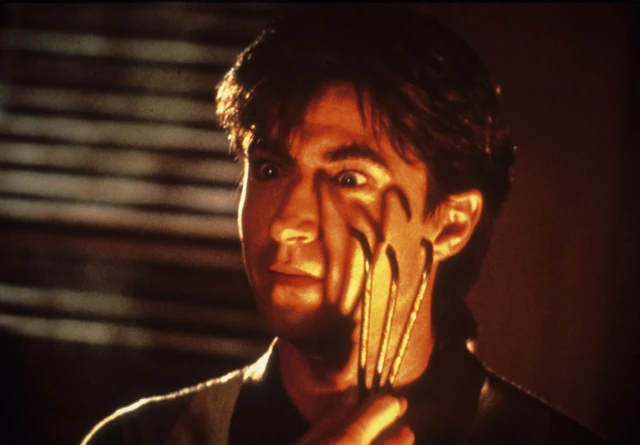
[Image description: Harold putting the fork to his face]
More tenuous than even that is the paragraph that follows, but I believe that nothing is too strange for Twin Peaks! Harold tells Donna and Maddy that the greatest secret of all is knowing the secret of who killed you, which is a bizarre comment to make; although it sounds profound, it doesn’t seem to mean very much at all. The usual interpretation, I imagine, is that this is foreshadowing of Harold’s own suicide, an interpretation which is backed up by his act of self-harm as he says the line. However, I’m going to posit an alternative explanation. The big question of Twin Peaks – before all the weird stuff kicked in, the question that everybody who was around in the 1990s knows – is who killed Laura Palmer? Harold is obsessed with people’s stories, and in much the same way as the viewer watching the whodunnit he seems to need closure on Laura’s story. Yet of all the unfinished stories in his cupboard, Laura’s seems to take disproportionate precedence (over Donna’s, for example), and furthermore, “knowing who killed you” seems specific and personal rather than general, as seen in the theory where it foreshadows his suicide. Is Harold, then, working for Laura in some form, helping her to find closure on her own story rather than be stuck screaming in alternate timelines or lodges? I suggest that Harold, as much as the planted diary, is a part of Laura’s attempt to save herself. It is Harold, after all, who carries the pages of Laura’s diary, suggesting some form of shared consciousness (or a pun stretched too far). In Part 8 we have seen Laura as an orb of good energy, unleashed on the world to counterbalance BOB – I don’t believe it unreasonable to assume that this energy can transcend the boundaries of life and death in order to save herself and restore order to the universe.
One of the most frustrating plot lines to follow in the show is that of Ben Horne – initially promising, the character is revealed to be a red herring, and his descent into madness and Civil War re-enactments feel like distractions from the main plot of the show, whilst the celery-chomping redeemed hotelier feels difficult to crack – is he for real? Or is this yet another plan to scupper the Martells? In this post, I want to argue that the Civil War plot line sees Ben manage to rid his body of BOB and become a better man.
[Image description: Ben Horne dressed as Robert E. Lee, waving the Confederate flag]
Although revealed not to be Laura’s killer as the show seems to set him up to be, Ben Horne is undoubtedly despicable. He owns an illegal casino and brothel, sleeps with underage girls and is ruthless in his illegal enterprises for capital gain. There are several indications, however, that Ben is not this evil just by character, but rather that during the first part of the show he is possessed by BOB.
I have written significantly about general indications that characters are possessed by BOB here [link opens in new tab], but the parallels between Ben Horne and Leland Palmer are so striking that they merit their own article. BOB manifests himself in Leland Palmer through an attraction to underage women – both Leland and Ben slept with several schoolgirls, the most notable being of course Laura, with whom they were both obsessed. Both have photographs of Laura which feature prominently in the show – when Laura dies, Ben puts his in his desk drawer, whereas Leland smashes his; although the latter’s behaviour is more destructive, both men seem to want to erase that part of their wrongdoing, like there’s a split in them, or an element of remorse. This idea of a split in them goes further – Leland’s death scene is memorable for the moment when BOB leaves him and he realises what he has done to his daughter. Ben has a similar moment with his own daughter; after nearly raping Audrey in One-Eyed Jack’s without realising her identity, he subsequently finds out and is deeply distressed by his own actions.
Also in this clip, however [around 2:42], we hear Coop reading the contents of Laura’s secret diary to Diane. He reads: “Someday I’m going to tell the world about Ben Horne. I’m going to tell them who Ben Horne really is.” This phrasing is odd, given that she’s discovered that he’s a bad man rather than that he has a secret identity. Maybe she’s just being melodramatic, but “who” is an interesting choice instead of “what Ben Horne’s really like”. Bear in mind that this is the diary in which she chronicles her time with BOB – given that they treated her much the same, it’s not hard to believe that BOB visited her through both men. Furthermore, the difference between Ben Horne, owner of One-Eyed-Jack’s, and Ben Horne, saviour of the pine weasels, fits exactly in place with the idea that pure evil [represented by BOB] and pure good exist in one place, again placing BOB at the heart of Ben’s wrongdoing at the start of the series – for more on that theory see here [link opens in new tab].
Finally, BOB is present in the final scene of the second series featuring Ben, where we see his head smashed into a mantlepiece by an enraged Hayward. Can I find a picture? No, unfortunately, although it’s pretty memorable. But I can find pictures of several almost identical wounds.
[Image description: Leland Palmer dying from a wound to the head, surrounded by Harry, Albert and Cooper.]
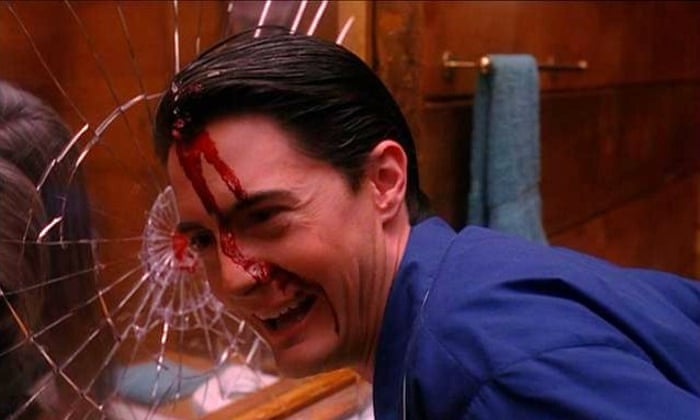
[Image description: Coop with a wound to the head, grinning, with a cracked bathroom mirror and BOB on the other side]
Admittedly the shot of Leland isn’t so good, but I’m working with Google Images. The point is that this is how BOB hurts people. This scene with Ben is often used to link him to BOB – I would actually argue the opposite. By this point in the show Ben has rid himself of BOB – he is attacked by Doc Hayward in the same manner that Leland attacks Maddy, by smashing her head into a wall. By this point, BOB is elsewhere – but he is still present in more places than just Leland and Coop. It is crucial, however, to note that at this point in the series Ben is clean – the reaction of an early Ben Horne to a scene of such confrontation would likely have been very different.
Ben’s descent into madness and re-enactment of the Civil War seems to me to be Horne cleansing himself of the presence of BOB. The first clue to this, surprisingly, is Ben’s love of vegetables, particularly phallic ones, which suddenly appears after he wakes from his trance. From then on, Ben is frequently seen with either celery or a carrot in his mouth without explanation. Take a look at this scene, for example.
Yet this vegetable obsession is a behaviour which is clearly paralleled in the old Horne’s obsessive cigar smoking. The old Horne was never seen without a cigar in his hand, both smoking with it and using it to point to just about everything. It is difficult to see the cigar as anything other than a symbol of decadence – more enjoyable and more expensive than a regular cigarette, it is a symbol of luxury, but this is a short-term pleasure that destroys you from within long-term. Historically, cigarettes and cigars have also been cinematic symbols for sex, and sexual indulgence is something tied up in Ben’s lifestyle. Much as I hate to draw on the phallic object as evidence, in the sandwich scene, Lynch uses it to great comic effect – is there anything more grossly sexual than the way Ben and Jerry devour those baguettes, the indulgence only compounded by Jerry stating that he ate four a day when in France? Having seen the way they seem to share this sexual gratification, the brothers’ joint involvement with – and trips to – One-Eyed Jack’s seem unsurprising.
Returning to the cigar, more common than the baguette in cinematographic history, it is also constantly burning and therefore inherently destructive not only to Horne himself but also to his external environment – the aesthetic of the Great Northern is entirely wooden. Let us now contrast this to the vegetable – much as I enjoy celery and carrots, these vegetables are some of the last objects that would be termed indulgent in the Western world. Surrounded by wood, these plants have a kinship to their environment, and nourish Ben – the opposite to the cigar. There is a definite sense of binary here.
So why is the Civil War plot line the crucial instigator of this sea-change? Well, I would argue that Dr. Jacoby hits the nail on the head in the clip above, when he says that “by reversing the South’s defeat in the Civil War, well in turn he’ll reverse his own emotional setbacks” [3:12]. When BOB leaves Leland, Leland dies trying to come to terms with what he has done (interestingly repeating “I loved her” about Laura just as Ben did), becoming slightly deranged, unable to cope with what he has done – I argue that this false reality of the Civil War helps Ben come to terms with the atrocities he committed under the control of BOB. The similarities between Ben’s situation and the Civil War are straightforward enough – both were slaveowners of a sort, the South fighting to maintain slavery and Ben keeping vulnerable young women in a brothel for sex and profit. It is more notable, perhaps, that throughout the Civil War plot line, Ben finds himself occupied by the spirit of Robert E. Lee – another BOB. We already know Roberts to be BOB from the letters left under his victims’ fingernails – this comparison is too clear to miss.
And so, waking up, Ben reverts to younger, more innocent times – like the child that we saw in the home movie above, when watching himself Ben seems to continually raise the cigar to his mouth, then pull it away, only smoking it at the very end of the scene. He and his brother both seem entirely innocent here, suggesting that they were corrupted by BOB somewhere along the line – I’ve written more about this corruption and why it’s indicated by dancing here [link opens in new tab], but suffice to say that the dancing of the Man from Another Place echoes through characters throughout the television show, indicating their corruption by BOB, and whilst Ben is no exception to this, his flashback to Louise Dubrowski dancing for the young Horne brothers feels like an inversion of this. Rather than the eerie music that plays throughout the rest of the dance scenes, this sweet, innocent, slow dance feel is much more reminiscent of when Coop meets the very wholesome Annie. As well as this, the bunk beds that the Horne brothers had in their first bedroom are now ironically inverted into those in their prison cell, the home of the guilty. Guilty is one binary opposite of innocent; the other, opposed to the sort of innocent that those young boys were, is corrupted. Yet the fact that we have several references to Ben’s boyhood goodness from the start is an indication that there is room for redemption – something proved by the Civil War plot line.
Only two things now remain: one is a far more tenuous theory I would like to add onto the end as food for thought, and the second is a question I can’t (yet) answer.
For the first, let’s return to this clip where Audrey brings in Jacoby, Bobby and Jerry to help with Ben. In the opening of this extract, she clearly tells Bobby that he can no longer suck up to Ben, but must now suck up to her. This is interesting mainly because Ben is the only person – that I can remember – who calls Bobby ‘Bob’. Although the similarity of names has been much remarked upon over the years, is there a suggestion here, mirrored through the slightly inept Bobby, that BOB is unable to retain his grip on the self-purifying Ben and is instead passing into Audrey? Maybe. It’s true that Audrey becomes increasingly cold-hearted and ruthlessly business-minded as the second series draws to a close, striving to emulate her father’s old ways and inherit the family business, although she ventures nowhere near the One-Eyed Jack’s side of things, to her credit (admittedly, it is no longer on the table). It is also true that BOB, when possessing Leland, used him as a vehicle to possess other people, the one he wanted the most being Laura – it’s not an unreasonable jump to impose this narrative on the mirroring father and daughter, Ben and Audrey. Nonetheless, I wouldn’t go as far as to describe it as conclusive.
The second thing I have to put out there is a question for further thought. When Ben Horne wakes up from his trance, the scene is shot like the final scene from The Wizard of Oz, with several lines directly taken from the film. This is too iconic a theft to pass unnoticed – but why? I’m not 100% sure yet, but I can give my take on it. The Wizard of Oz is the most famous of all it-was-all-a-dream stories – and is arguably the only one that has ever worked. The premise is that Dorothy is deeply discontent at home in Kansas, and that it takes a dream that is ostensibly wonderful in many ways to make her realise what a wonderful life she has back at home. Crucially, this dream contains many of the people closest to her in real life, all in odd disguises, who she identifies when she wakes up as having been a part of it. Ben Horne’s story is the same in many ways. He spends his dream as Robert E. Lee, Confederate general – and he acknowledges that it was a wonderful dream. But that – or, more frankly, BOB – is not the sort of man that he wants to be, and the life of a slave-owner is not the sort of life he wants to live. I’ll put the two scenes side by side so you can see what you think – but I think that this direct comparison to The Wizard of Oz clinches the idea of the Civil War subplot as a kind of dream therapy. If an odd sort.
In this post I want to argue that BOB is present in everyone in Twin Peaks, not just in Leland and Coop. I should say that this theory draws heavily on the theory of doubling [link opens in new tab], so if you haven’t read that, I would recommend going there first. However, it’s not essential.
The Man From Another Place gives Coop the information he needs to spot Leland Palmer back in S01E03 with his grey hair and dancing, both features of Leland’s behaviour when possessed by BOB. To sum up the conclusions from analysing the show’s use of doubling, BOB seems to be a metaphor for the evil in all of us, as stated by Albert quite early on. As a result, it seems odd that he is largely confined to Leland Palmer for the first two series.
Unless, of course, he’s not.
I don’t dispute that Leland is the only character to have his hair change colour overnight. Dancing, on the contrary, is a running theme in Twin Peaks. First, I direct you to “The Dance of the Dream Man” as Angelo Badalamenti puts it.
Let me draw your attention to what I think are the two most distinctive aspects of this clip. The first is the finger clicking, which is the hallmark of the dance of The Man From Another Place. The second is the instrumentation, which is heavily percussive and also highlights the clicking noise.
There are many notable instances of Leland Palmer dancing – often to Rodgers and Hammerstein, although I can’t work out why – but I’ve put probably the best known one below as a contrast.
It’s true that the finger clicking isn’t as apparent here as it is in other clips of Leland, but in a piece of music which at first listen seems radically different to the one in the Lodge we find exactly the same percussive elements, bizarrely so. The most important reason for choosing this clip, however, is that everybody joins in. Likewise, in the “I’m back!” scene, where a slightly deranged Leland dances for the Horne brothers when rejoining the Great Northern, both of them join in.
This isn’t just one of Twin Peaks‘s idiosyncrasies. We can expect everybody at the Great Northern to be able to dance slightly awkwardly, but the fact that they join in is odd to say the least, given that Leland is clearly very distressed. This oddness is compounded by the video with the Horne brothers – where did Jerry learn to worm? And where did Ben learn to tap dance? Both of these seem – to me – out of keeping with their respective characters. What is more, Leland isn’t the one clicking in this video – the undoubtedly evil Ben Horne is.
The image of people joining in with dancing is a particularly important one, because one of the key ideas behind the lodges is that fear is drawn to fear, and love to love. This is why there is such a concentration of romance in the Double R Diner but nowhere else – in a short string of episodes, where the rest of the show is building to a dramatic and relatively scary conclusion, there are far too many scenes of comic romance in this one place to fit tonally with the rest of the show. When I first watched this, it was something that my family kept commenting on – these tonal breaks are very obvious, and crucially they’re all concentrated in one place. The flip side of that is of course Josie’s death – it’s never confirmed or denied whether BOB was possessing Josie at any point, but we do know he was drawn to her death by the sheer amount of fear present. The idea, then, of the presence of BOB (in the dancing) setting off similar responses in those around him is really not that far-fetched.
Even then, we could perhaps dismiss this as a coincidence. But the fact is, this behaviour is apparent in a lot of characters throughout the series, both before and after dancing is confirmed as a sign of the presence of BOB. It was planned, right from the pilot. Take a look at this 6 second clip – when you first watch the pilot, it seemed like a quirk, and most people (myself included) forgot about it.
The person who published this to YouTube describes it as “the single most important story telling device in the entire series”. They say no more – I can’t tell if they’re being sarcastic or not. But in my opinion, they’re not far wrong. Check out the way he clicks at his locker, his red shirt and of course the exact same instrumentation, the focus on the clicking sound mixed with the slightly blurry percussion (a synaesthesic description – I hope you understand what I mean). This is undoubtedly a reference to The Man From Another Place – in a total randomer in the first episode, who wiggles his way off the screen never to be seen again. Surely this suggests that the influence of BOB is far more widespread than thought.
The next important – and probably next most famous – incidence of dancing is by Audrey, quite early on, in the Double R Diner. Notice the instrumentation again – it’s exactly the same, despite different tracks – Badalamenti is deliberately connecting these pieces of music. There is also a tenuous link to be made with Audrey’s maroon top – I’ll leave that there, take it or leave it. What is perhaps more important is the presence of a non-dancing Donna in this scene. This ties into the theory of doubles [again, link opens in new tab], so once again, if you haven’t read it I would advise you to go there first.
Doubling is generally recognised to various degrees in Twin Peaks, but Audrey and Donna are probably the second most recognised pair (after Laura and Maddy), to the point where an article about this actually made it into Huffington Post, which you can read here [link opens in new tab]. As I wrote in my post on the mirrors in the show, Donna and Audrey are set up as two sides of the same coin from the start. They look incredibly similar, which is later explained by the fact that they’re actually half-sisters. They both represent sides of Laura, and they both set out to solve her murder in radically opposite ways. Audrey seems to be the bad side to Donna’s good girl image, an extension of the symbolic personality split we see in BOB. This is apparent in this clip – just look at the way their hair is parted or at their identical make-up. They’re made to look as similar as possible. And – just as BOB tempts Leland to evil – here is Audrey, and from the look she gives Donna, it is clear that she is inviting, even daring her to dance with her. Donna, on the other hand, doesn’t look too impressed, but the camera work tells us that this scene is not just about Audrey – it consistently pans back to Donna to show her reaction, suggesting that this is about the relationship between the two girls. It’s also worth noting that Audrey refers to the music as “dreamy”, and that the similar (although not identical) piece played in the Lodge in episode three and later is referred to as “The Dance of the Dream Man” on the soundtrack.
There are so many instances of dancing in the show that there are some I’m not going to dwell on – I’m not focusing on the dancing at the pageant, although there’s a lot of it. I’m just going to take a couple more select moments – sifting through the entire show is a mammoth task!
Firstly, there’s a scene which is often forgotten and seems largely irrelevant to the rest of the show – the scene where Ben and Jerry (I assume the joke has already been made) are in a prison cell together and they see a woman dancing with a flashlight, a mixture between a flashback and a dream sequence. Interestingly, the music here is the same as the music we hear when Coop first meets Annie, a kind of schmaltzy slow dance number – not what I expected to hear at all, at first. When I thought about it, however, it started to make sense. Most other dance scenes seem to be analyses of people as they slip over the edge into evil. The Hornes, however, are already reprehensible – their memory of the dance, which certainly seems to be a dance of temptation, is one of reverse, remembering the time before that, when they were young and innocent boys, as shown in the scene.
A couple more before I close. Once Leland’s dancing was revealed to have been the giveaway, I started obsessing over people dancing, seeing if I could spot who BOB was going to inhabit next. The first one I saw was Bobby. The name doubling (Bobby and Mike are best friends, I am the millionth person to point out) made me think that this was it. Bobby was going to commit murder. The first ten seconds of the clip below have the weird dance/clicking with no context as well as the dreamy music. But here, rather than being the focus, it is just thrown in casually, which I first assumed was to try to slip it in unnoticed – kind of sloppy, but hey ho. However, this is (as far as I know) never referenced again – in hindsight, it feels cleverer than that, like it is Lynch and Frost deliberately trying to highlight the undercurrent of evil throughout the town, a recurring theme in the series and arguably what makes it so haunting and unsettling.
I can’t find a clip of the scene where Nadine gets her memory back and Ed has to work out what to do, but as he decides the same thing happens as with Bobby there – deciding whether to stay unhappy with Nadine or choose love with Norma, he gives a weird little click dance, just for a second.
I don’t have the time or Wi-Fi connection to go back through the entire series, but I would hazard a reasonable guess that Bobby, Ed, Audrey, the Hornes and so forth are not the only characters who engage in this odd clicking. A running theme in Lynch’s work is the idea that there is a veneer of evil underneath all of small town life, and this certainly fits with the way he and Frost present evil in Twin Peaks.
A coda to this is the really interesting scene where Coop and Annie dance together. It’s not just spontaneous – there’s a lot of talk of dancing between them before it happens, presumably to highlight it as important, and I can’t quite make head or tail of what Lynch and Frost are trying to do in this scene. I’ve put it right at the bottom – notice the interesting ups and downs of the percussion, becoming blurrier as Coop approaches Annie and then fading as they part. Note also that this is the scene which shows the Lodge connecting with the “real” world, as BOB comes out of it fully formed. The Giant speaks to Coop here, but we also have the microphone lowering by itself, suggesting the presence of The Man From Another Place. Finally, Annie and Coop make so many references to “the other side”, so many and with such odd phrasing that it doesn’t seem like they’re talking about the pageant any more. And, of course, the mystery which haunts me every day – having received that message from the Giant, why didn’t Coop try to stop Annie from entering the pageant? Is BOB already controlling him? This seems unlikely… This is one of the scenes from Twin Peaks that keeps me up at night – if anyone can shed any light I’d be immensely grateful.
Or, if you’d rather, just enjoy the lovely scene of Coop and Annie dancing before everything goes wrong.
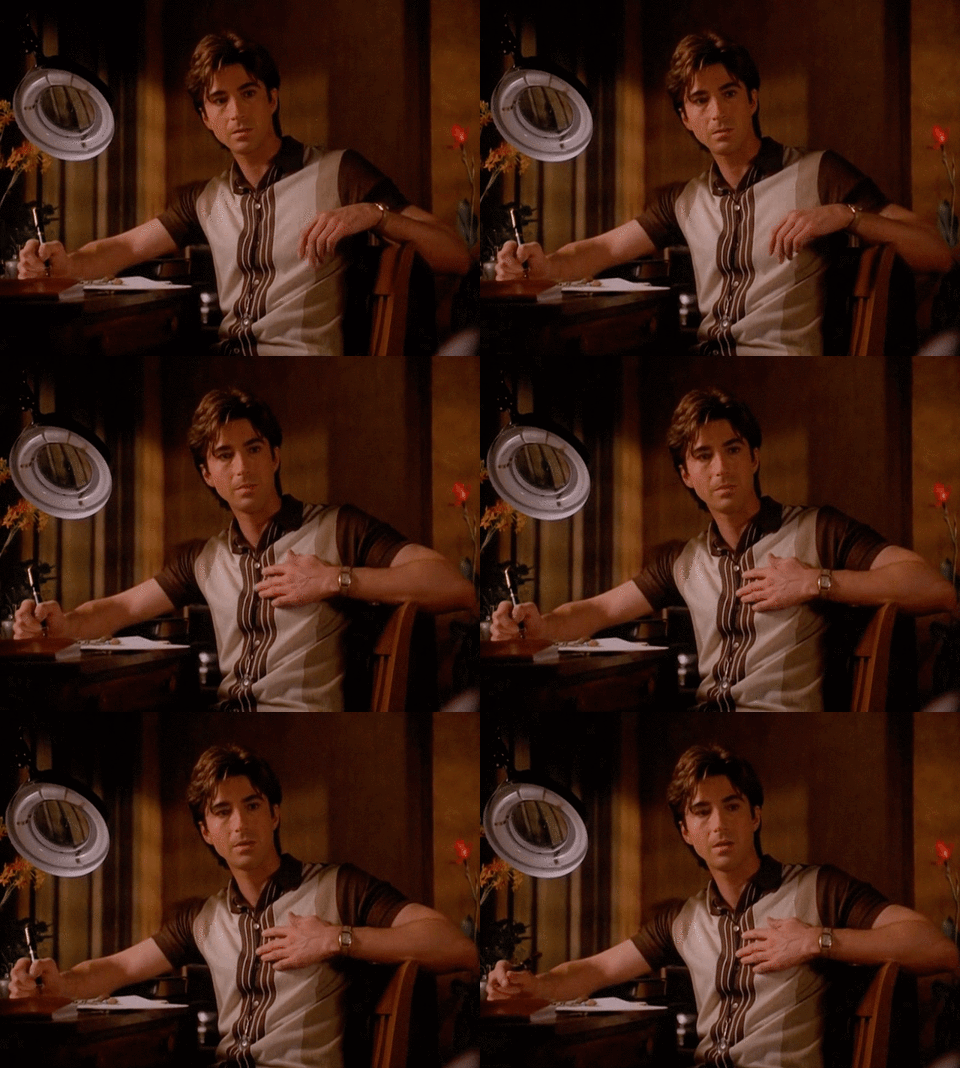
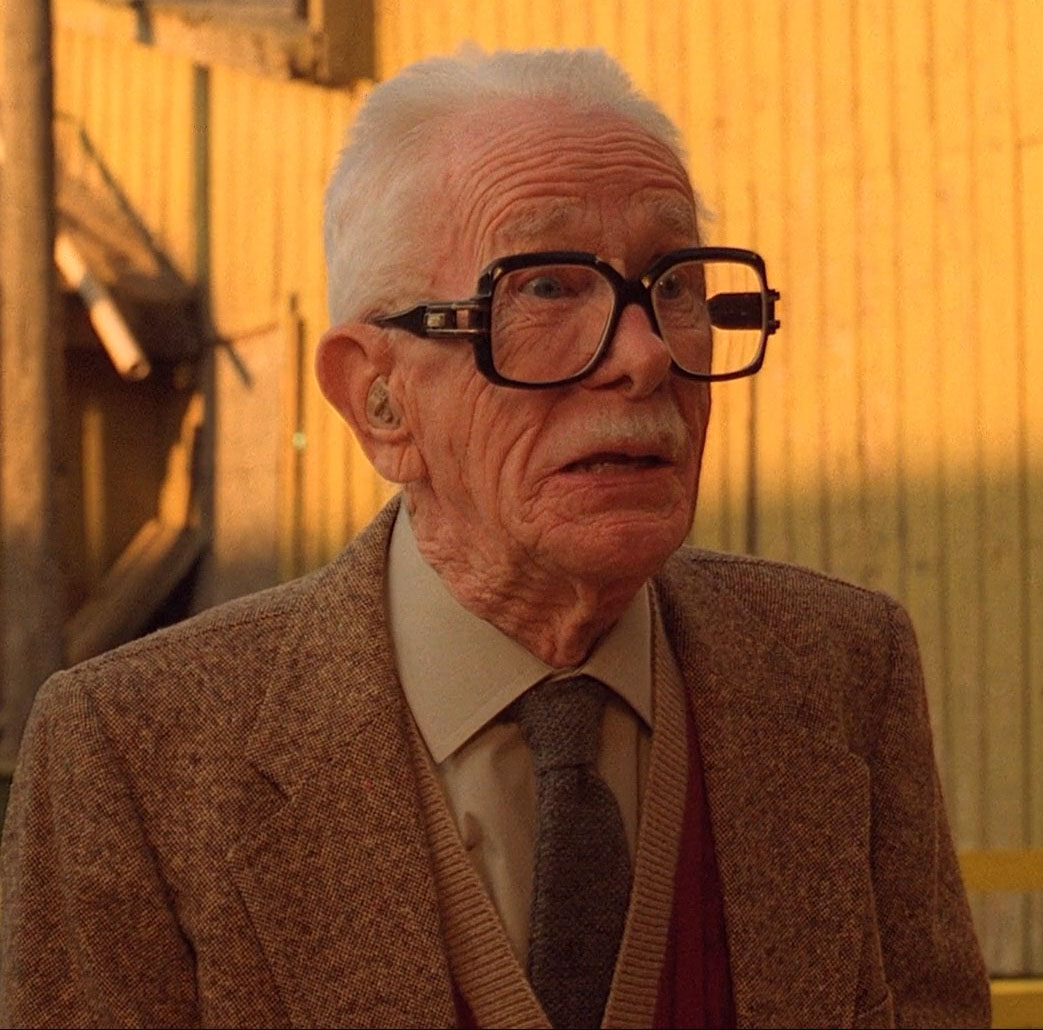
Surely the most frustrating moments in Twin Peaks were those of the waiter, performing regular room service for Coop as he’s bleeding out on the floor, and the bank teller, taking an aeon to walk across the room to a bank vault that we didn’t really care too much about whilst we waited to find out what was happening to Cooper over in the Lodge.
Well. Here’s why.
I wasn’t around in the early nineties so I’m not the world’s biggest authority on this, but those who were have told me about Lynch and Frost’s constant fighting with ABC. As the show went on, it went from having some of the best ratings in television to… well, not so large a viewership, something that has been blamed on how slow the story is to develop. An audience hooked on the initial mystery – who killed Laura Palmer? – were disappointed or maybe just bored when they found out that a basic whodunnit was not the sort of story they were going to get. ABC forced Lynch and Frost to reveal the killer far earlier than they wanted to – the legend goes that Lynch never wanted to reveal the killer at all, which doesn’t surprise me, although I don’t know how substantiated that claim is – but they got around ABC by keeping whatever the heck was going on with BOB a mystery. However, the introduction of Windham Earle and storylines which were either increasingly kooky or mundane didn’t help their viewership, and eventually, seemingly due to the pace of the show, Twin Peaks was cancelled after only two series.
How does that link to the slow walkers, you ask? Well…
[The slow waiter giving Coop a thumbs up in the Great Northern – Coop at this point is out of vision but lying on the floor bleeding to death]
The waiter first appears when Coop has been shot, coming to bring him room service. He is infamously slow and doesn’t seem to recognise that Coop is in danger of dying. Bear in mind that the original audience were left on a cliffhanger for a year in one of the most watched TV shows in the States – and what a cliffhanger. Everybody wants to know – who shot Dale Cooper? Will he survive? And we expect an opening scene which resolves at least the latter of those mysteries. But instead we get – this. This scene is doubly intense for the audience because at the time of transmission, this isn’t just a five minute scene – it’s been a year. The sound of the clock ticking in the background intensifies Coop’s danger, but it also reminds the audience of just how long they’ve spent.
In this situation, I argue that the audience is Andy. The audience who tuned in for series 2, having been waiting a year to find out, are exactly the same as Andy, who after a year is still on the end of the phone. It’s odd behaviour for a lawman – an FBI agent is on the phone to you, you hear a gunshot and then nothing – and you stay for five minutes just asking the same question with no response? Even for a man like Andy, it’s not great. Andy here isn’t just your regular lawman – he’s a stand-in for the audience who stayed asking that question.
Who, then, is the waiter who hung up on them? The answer is, of course, Lynch and Frost. The term “waiter” is of course a pun on how long they have spun out this series – and just how much further they’re going to do so, and the waiter’s behaviour – erratic, slow, symbolic – is surely Twin Peaks in a nutshell. If you want something else to link the waiter to Lynch (though not Frost), his behaviour at the end of the scene is enough – he gives Coop the thumbs up three times, needing Coop to do the same, returning to the room twice to do so. There’s only one other person who does that, and the waiter pulling the thumbs up three times is surely meant to make it stick in the mind, so that when we finally meet him the point is hammered home.
[Image description: Gordon Cole and Dale Cooper sharing a thumbs up in the sheriff’s department]
That’s right. Gordon Cole. Played by David Lynch.
This, of course, throws up some interesting questions when it gets to “that gum you like is going to come back in style”. The waiter is an interesting character – on first watch, seeing him in the Lodge at the end of the second series where he behaves like a Lodge creature (as he does by referencing the gum), I assumed that he was another of Coop’s visions. But of course he interacts with the Major and Leland in this scene, making him as far as I know the only character who seems to wholly belong to both worlds. This, coupled with the way he brings information (the gum, the coffee) makes him a good fit for Frost and Lynch. But if Frost and Lynch have this presence in the show, why do they use it to tell Coop that Leland killed Laura? That I don’t know for sure, but my pet theory is that it’s another jibe at the network – the powers that be are stepping in earlier than necessary to force Coop into understanding who killed Laura Palmer – yet it only makes things more confusing, which is a nice middle finger to them.
[Image description: Close-up of the bank teller, also known as Dell Mibbler]
I would love to have a theory about the name Dell Mibbler – it’s such a wonderful name, and so bizarre, it can’t have been chosen by accident. At this moment in time, however, I don’t. Despite this, he is clearly linked to the waiter – they both walk desperately slowly at critical moments in the plot. It is possibly worse in Mibbler’s case, as his walking takes up important screen time whilst the audience is waiting to find out what is happening to Coop in the Lodge. On top of this, he is a bank “teller”, an even more obvious pun creating a link with Lynch and Frost.
At this point, bear in mind, the show has been cancelled. This, as far as anybody knows, is the final installment. The appearance of a character so similar to the waiter at such a critical moment should have rung alarm bells re cliffhangers. Again, this time forced to end their show due to its pace, they subverted the will of ABC by creating what I think must be the longest wait between two consecutive series in TV history – twenty-six years (intended to be 25).
[Image description: Laura Palmer in the Red Room, subtitle saying “I’ll see you again in 25 years.”]
With this in mind, the slowness of the teller in an episode which is supposed to round things off nicely and finally is one last laugh on the part of the show’s creators. This is compounded by the situation with the mystery box, a subplot in the final few episodes of the show which never seemed to go anywhere – box after box without any answers, much like the show itself. The bomb in the bank vault – after all that – is even then not really a closed ending – for twenty-five years, audiences waited to know who (if anyone) had survived, with Pete and Audrey notably in the building seemingly for no reason other than to create a cliffhanger with more emotional hooks than just Andrew. If this feels arbitrary – you’re right. It is. But it foreshadows the total ambiguity of the final cliffhanger with Coop and BOB, and it does so in a darkly comic way, like Frost and Lynch really are laughing at ABC.
If, now, we bring Andy-as-audience back into it – we’re getting tenuous here, but bear with me – you may or may not remember that just before the bomb blows, the phone rings in the bank and someone yells “it’s a boy!” several times as the teller meanders over to the phone. He never makes it there, of course. The only two people who would feasibly be making that telephone call that we’ve met are, of course, Andy and Lucy, who have been expecting a child for most of the show. Why they are calling the bank we don’t know, but this time the teller/waiter is not putting the phone down but instead making his way – slowly but surely – towards the phone before being cut off by a bomb motivated by corporate greed. If that’s not a metaphor for ABC cutting off Frost and Lynch and leaving the audience with a cliffhanger that would last twenty-six years (and at the time looked indefinite) – I don’t know what is.
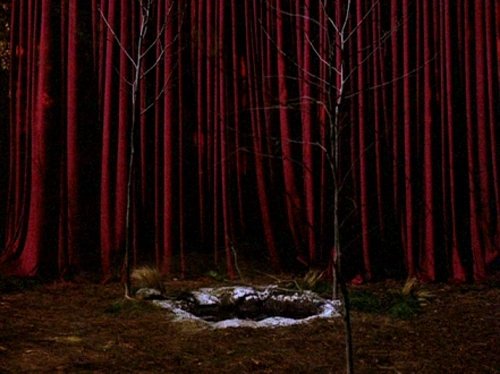
[Image description: Sycamore trees at the entrance to the Lodge]
Note: This theory only deals with information from the first two series of the show.
This post is going to detail native mythology as used in Twin Peaks, and will go some way towards explaining the meaning of both owls and trees/wood within the show.
Firstly – trees. Maeclair.net writes an informative post on how in some Native American faiths sycamore trees are seen as holding the spirits of the dead, you can find that here:
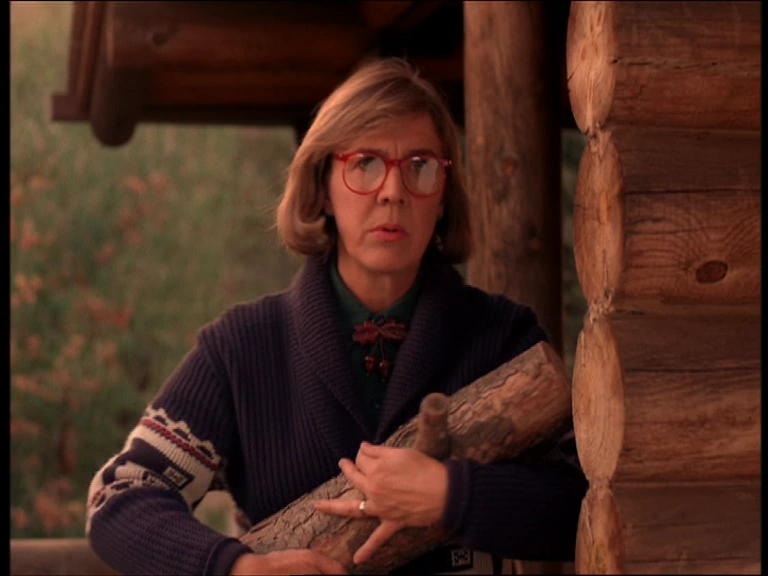
This makes a lot of sense in relation to sycamore trees within the show – the entrance to the Lodge is in a grove of sycamore trees, so it makes sense that this is where the link between this world and the next is the strongest. There are, of course, several other incidences of trees being connected to the afterlife in Twin Peaks. Firstly, there is the Log Lady.
[Image description: the Log Lady holding her log]
This is one of the most iconic quirks of the show, and something that is often passed off as “Lynchian” without much further explanation. Of course, the reason that the log knows so much is that it contains the spirit of the Log Lady’s dead husband, or so she says. This is another incidence of not only spirits of the dead within trees, but also – crucially – the trees or the wood being the way in which these spirits connect to our world, like a connection point. Although we don’t see her communicate with the Twin Peaks universe again in the series, Josie’s death is similar in the notorious scene where she seems to meld into the bedside table.
[Image description: Josie’s face superimposed over the drawer knob before her face becomes embedded in the wood]
Whilst it is true that the bedside table doesn’t communicate as Josie for the rest of the series, both when she is superimposed on the knob and later a part of it she is not just static but screaming in fear, trying to communicate. The wood is not just a place to house these spirits but creates a place where we are closest to them. This is amplified, we assume, by the significance of the sycamore tree and the trees’ proximity to one another when creating a physical opening. This is particularly important in the town of Twin Peaks, whose aesthetic seems built around wood – think of the Great Northern, or the log cabin. Twin Peaks is a place which is particularly close to the other world, which is why the spirits are so strong here. The cinematography and music of the show combine to create an aesthetic which is profoundly haunting (the only exception being the diner, unsurprisingly), perhaps an attempt to convey the atmosphere of a spiritually infused town, although I grant that this last bit is tenuous. The point that large amounts of Twin Peaks takes place in a forest called Ghostwood, however, does lend this theory some weight.
If the trees are the spirits of the dead of our world, then the owls are the spirits from the other world. This one was not so hard to figure out – the owls seem to have pulled the Major to the Lodge, and the Log Lady is keen on having a conversation where they can’t see her. They are only ever (as far as I recall) associated with evil, suggesting that they are specifically linked to the “Black Lodge” but don’t possess and kill in the same way as Killer BOB, nor do they communicate like The Man From Another Place – rather they seem to be messengers, or the eyes and ears of the Lodge in our world. They do seem to communicate with TMFAP however – he says that “where we’re from, the birds sing a pretty song”, underlining the birds as a link between the two worlds. Furthermore, in some Native American faith systems, the cry of the owl is associated with a coming death, and likewise in the Aztec and Mayan faith – these animals were seen as the messengers of death. Notably, for the Apache people, to dream of an owl meant that death was approaching. This, like the sycamore trees, seems to provide a clear link back to the Native American lore that permeates Twin Peaks, where the spirits from our world and the Lodge are present in the natural features which are so widespread in the town.
I’m not the first person to note the abundance of doubling and mirroring in Twin Peaks. Nor am I going to spend my time listing doubles – plenty of people have done that before me. Back of the Cereal Box has done a particularly good masterpost on it here:
The sorts of doubles that abound are characters – you could take Laura and Maddy, but equally Donna and Audrey or Norma and Shelley as visually similar yet diverging in personality, as though they are foils for one another. Doubles also appear in places – the Double R Diner or even Twin Peaks itself – or in storylines that repeat themselves – Evelyn’s story neatly mirrors Josie’s. The White Lodge, the Black Lodge. Earle set up as Cooper’s traditional nemesis. BOB only being visible in mirrors. Etcetera.
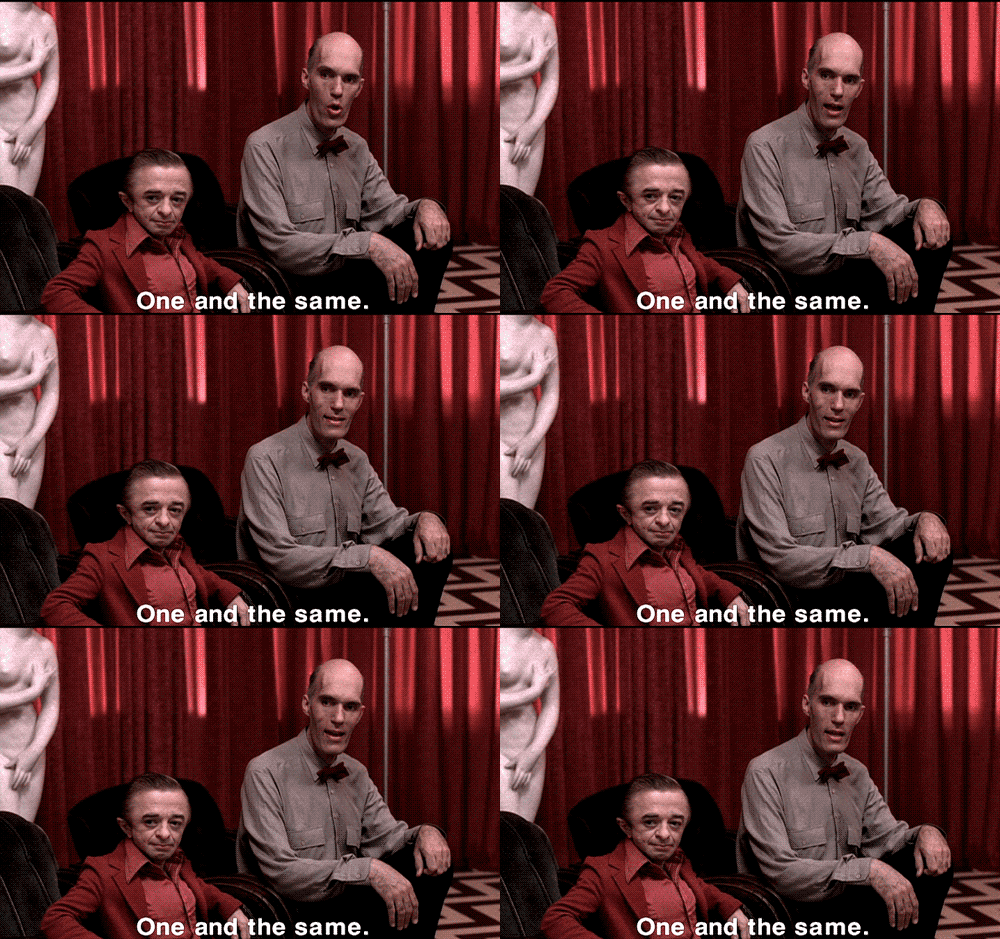
What I want to suggest in this theory is that the doubles we see are actually only one. This is easy to argue for some pairs – Laura and Maddy are of course both played by Sheryl Lee, and the beautiful opening sequence to the show famously only shows one of the town’s peaks. We might go back to the words of the Giant, when Coop meets him in the Black Lodge.
[GIF description: Giant and TMFAP in the Red Room in chairs, Giant saying “one and the same”]
These supernatural beings seem twinned by their unusual heights, the Giant helping Coop whereas the Man from Another Place is associated with Killer Bob. This is a pattern which fits with our character doubles – Maddy was a goody two shoes where Laura was working at One-Eyed Jack’s with a cocaine habit; Donna and Audrey both set out to find out what happened to Laura, but Donna goes down the Meals on Wheels route and Audrey goes to One-Eyed Jack’s; Norma and Shelley are in the same situation with their husbands, but Norma waits it out and plays by the rules whereas Shelley exploits Leo’s disability; Coop and Earle were both in the same job, in love with the same woman, but one became a homicidal maniac whilst the other became a constantly genial law enforcer – etcetera (again, go through Back of the Cereal Box for a much more comprehensive list of these). Yet despite the Evil Twin motif running through this mirroring, the Giant suggests that he and The Man from Another Place are actually “one and the same”.
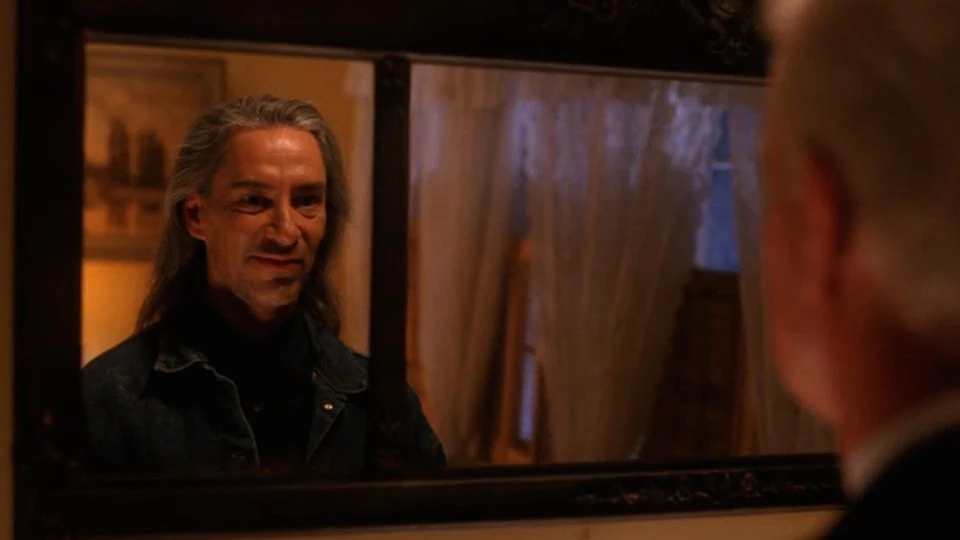
This might remind us of just after the team work out that Leland killed Laura and it is suggested that BOB is actually “the evil that men do”. It’s unlike Lynch to put meaning in such specific terms, but it is true that he seems to have an obsession with the dark underbelly of the happy American life – something which Twin Peaks is very big on. If we follow that line of thought through – that possession by BOB is a metaphor visually evoking evil, but that in fact the evil is already inside of us – we arrive at some pretty interesting conclusions.
[Image description: Leland Palmer looking into the mirror, seeing Killer BOB]
Separating people into good and evil twins is useful for understanding good and evil in the characters, or fear and love if we want to think about it in the terms of the Lodge. But good/bad is a gross oversimplification for most of the pairs listed in the Masterpost. Shelley Johnson is a good example of someone whose actions are technically reprehensible – but who can blame her? The show divides good and bad into white and black via the lodges – something which should be echoed in Earle and Coop’s chess game, but it is Earle who plays white. Maddy should be Laura’s White Lodge double, but again it is Laura who has white-blonde hair and Maddy who has dark hair. There is a visual suggestion here that good and evil are not as clear-cut as we think, and that they’re actually conflatable. This is particularly true of Laura and Maddy – we know Laura was a Meals on Wheels volunteer as well as working for One-Eyed Jack’s – in this sense she’s the prototype for good and bad in one person – but equally check out the way the Palmers seem to use Maddy as a replacement for Laura, or even better the scene where Maddy impersonates Laura to fool Doctor Jacoby, and we can see Lynch and Frost playing with the idea that they’re one and the same, time and again.
[Image description: Maddy in a blonde wig impersonating Laura on the phone to Dr. Jacoby]
The conflation of good and bad is even more prominent in the final episode of Series 2 when we finally go inside the Lodge. The Man from Another Place notably refers to the Red Room as the waiting room. The corridor to the Red Room has two entrances – ostensibly to different rooms – one marked by the Venus de Milos, the other marked by nothing. I suggest that the Venus de Milos represents love more than any other artwork, certainly in terms of its notability in the Western tradition, and that the absence of anything at the other entrance shows fear as an absence of love. It is certainly implied that the Venus entrance will lead to the White Lodge and the other the Black Lodge. That, of course, is not what we get. The room connected to both entrances is instead the Red Room – we know from its entrance that the Lodge has a peculiar relationship with both space and time, so I feel comfortable in hazarding the statement that the room is actually one and the same, although masquerading as two. Notably, the floor of the Red Room is black and white zig-zags – a mix between black and white, or fear and love.
[Image description: Red Room floor, focusing on black and white zig-zags]
Thinking as well about the language that is spoken in the Red Room – spoken backwards and then played forwards – we can see that something which is ostensibly the opposite of our language actually resembles it – in other words, it is a doppelganger, but it is also just the same in meaning. Think too of BOB – a palindrome which the Man From Another Place highlights with the longer palindrome, “wow, BOB, wow” – it’s the same both ways. This all leads me to suggest that the Red Room is the Lodge – Black and White, in one. The show operates on the level of the fantastic – and what an incredible supernatural mythology it has – but also on the metaphorical, and the use of the evil twin trope which is then subverted into unity of good and evil does a lot to pull apart the binary of good and evil usually seen on television. Coop asks Harry if he can really believe that Leland Palmer would rape and murder his own daughter without being possessed by BOB, and Harry admits that BOB is far easier to believe – perhaps, for the audience, BOB is the way in to understanding an evil, residing to degrees within everyone, which otherwise seems incomprehensible.