
One of the most frustrating plot lines to follow in the show is that of Ben Horne – initially promising, the character is revealed to be a red herring, and his descent into madness and Civil War re-enactments feel like distractions from the main plot of the show, whilst the celery-chomping redeemed hotelier feels difficult to crack – is he for real? Or is this yet another plan to scupper the Martells? In this post, I want to argue that the Civil War plot line sees Ben manage to rid his body of BOB and become a better man.

[Image description: Ben Horne dressed as Robert E. Lee, waving the Confederate flag]
Although revealed not to be Laura’s killer as the show seems to set him up to be, Ben Horne is undoubtedly despicable. He owns an illegal casino and brothel, sleeps with underage girls and is ruthless in his illegal enterprises for capital gain. There are several indications, however, that Ben is not this evil just by character, but rather that during the first part of the show he is possessed by BOB.
I have written significantly about general indications that characters are possessed by BOB here [link opens in new tab], but the parallels between Ben Horne and Leland Palmer are so striking that they merit their own article. BOB manifests himself in Leland Palmer through an attraction to underage women – both Leland and Ben slept with several schoolgirls, the most notable being of course Laura, with whom they were both obsessed. Both have photographs of Laura which feature prominently in the show – when Laura dies, Ben puts his in his desk drawer, whereas Leland smashes his; although the latter’s behaviour is more destructive, both men seem to want to erase that part of their wrongdoing, like there’s a split in them, or an element of remorse. This idea of a split in them goes further – Leland’s death scene is memorable for the moment when BOB leaves him and he realises what he has done to his daughter. Ben has a similar moment with his own daughter; after nearly raping Audrey in One-Eyed Jack’s without realising her identity, he subsequently finds out and is deeply distressed by his own actions.
Also in this clip, however [around 2:42], we hear Coop reading the contents of Laura’s secret diary to Diane. He reads: “Someday I’m going to tell the world about Ben Horne. I’m going to tell them who Ben Horne really is.” This phrasing is odd, given that she’s discovered that he’s a bad man rather than that he has a secret identity. Maybe she’s just being melodramatic, but “who” is an interesting choice instead of “what Ben Horne’s really like”. Bear in mind that this is the diary in which she chronicles her time with BOB – given that they treated her much the same, it’s not hard to believe that BOB visited her through both men. Furthermore, the difference between Ben Horne, owner of One-Eyed-Jack’s, and Ben Horne, saviour of the pine weasels, fits exactly in place with the idea that pure evil [represented by BOB] and pure good exist in one place, again placing BOB at the heart of Ben’s wrongdoing at the start of the series – for more on that theory see here [link opens in new tab].
Finally, BOB is present in the final scene of the second series featuring Ben, where we see his head smashed into a mantlepiece by an enraged Hayward. Can I find a picture? No, unfortunately, although it’s pretty memorable. But I can find pictures of several almost identical wounds.

[Image description: Leland Palmer dying from a wound to the head, surrounded by Harry, Albert and Cooper.]
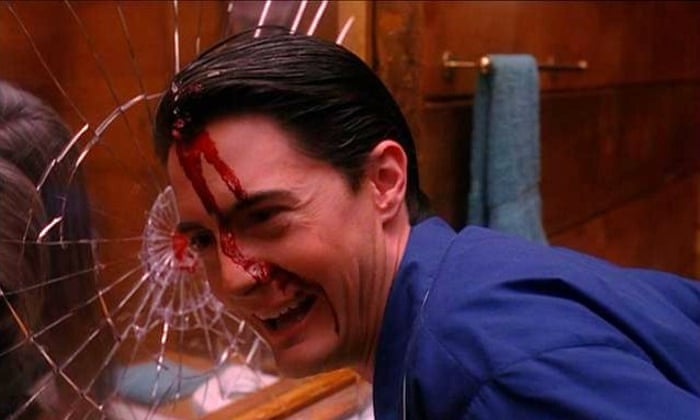
[Image description: Coop with a wound to the head, grinning, with a cracked bathroom mirror and BOB on the other side]
Admittedly the shot of Leland isn’t so good, but I’m working with Google Images. The point is that this is how BOB hurts people. This scene with Ben is often used to link him to BOB – I would actually argue the opposite. By this point in the show Ben has rid himself of BOB – he is attacked by Doc Hayward in the same manner that Leland attacks Maddy, by smashing her head into a wall. By this point, BOB is elsewhere – but he is still present in more places than just Leland and Coop. It is crucial, however, to note that at this point in the series Ben is clean – the reaction of an early Ben Horne to a scene of such confrontation would likely have been very different.
Ben’s descent into madness and re-enactment of the Civil War seems to me to be Horne cleansing himself of the presence of BOB. The first clue to this, surprisingly, is Ben’s love of vegetables, particularly phallic ones, which suddenly appears after he wakes from his trance. From then on, Ben is frequently seen with either celery or a carrot in his mouth without explanation. Take a look at this scene, for example.
Yet this vegetable obsession is a behaviour which is clearly paralleled in the old Horne’s obsessive cigar smoking. The old Horne was never seen without a cigar in his hand, both smoking with it and using it to point to just about everything. It is difficult to see the cigar as anything other than a symbol of decadence – more enjoyable and more expensive than a regular cigarette, it is a symbol of luxury, but this is a short-term pleasure that destroys you from within long-term. Historically, cigarettes and cigars have also been cinematic symbols for sex, and sexual indulgence is something tied up in Ben’s lifestyle. Much as I hate to draw on the phallic object as evidence, in the sandwich scene, Lynch uses it to great comic effect – is there anything more grossly sexual than the way Ben and Jerry devour those baguettes, the indulgence only compounded by Jerry stating that he ate four a day when in France? Having seen the way they seem to share this sexual gratification, the brothers’ joint involvement with – and trips to – One-Eyed Jack’s seem unsurprising.
Returning to the cigar, more common than the baguette in cinematographic history, it is also constantly burning and therefore inherently destructive not only to Horne himself but also to his external environment – the aesthetic of the Great Northern is entirely wooden. Let us now contrast this to the vegetable – much as I enjoy celery and carrots, these vegetables are some of the last objects that would be termed indulgent in the Western world. Surrounded by wood, these plants have a kinship to their environment, and nourish Ben – the opposite to the cigar. There is a definite sense of binary here.
So why is the Civil War plot line the crucial instigator of this sea-change? Well, I would argue that Dr. Jacoby hits the nail on the head in the clip above, when he says that “by reversing the South’s defeat in the Civil War, well in turn he’ll reverse his own emotional setbacks” [3:12]. When BOB leaves Leland, Leland dies trying to come to terms with what he has done (interestingly repeating “I loved her” about Laura just as Ben did), becoming slightly deranged, unable to cope with what he has done – I argue that this false reality of the Civil War helps Ben come to terms with the atrocities he committed under the control of BOB. The similarities between Ben’s situation and the Civil War are straightforward enough – both were slaveowners of a sort, the South fighting to maintain slavery and Ben keeping vulnerable young women in a brothel for sex and profit. It is more notable, perhaps, that throughout the Civil War plot line, Ben finds himself occupied by the spirit of Robert E. Lee – another BOB. We already know Roberts to be BOB from the letters left under his victims’ fingernails – this comparison is too clear to miss.
And so, waking up, Ben reverts to younger, more innocent times – like the child that we saw in the home movie above, when watching himself Ben seems to continually raise the cigar to his mouth, then pull it away, only smoking it at the very end of the scene. He and his brother both seem entirely innocent here, suggesting that they were corrupted by BOB somewhere along the line – I’ve written more about this corruption and why it’s indicated by dancing here [link opens in new tab], but suffice to say that the dancing of the Man from Another Place echoes through characters throughout the television show, indicating their corruption by BOB, and whilst Ben is no exception to this, his flashback to Louise Dubrowski dancing for the young Horne brothers feels like an inversion of this. Rather than the eerie music that plays throughout the rest of the dance scenes, this sweet, innocent, slow dance feel is much more reminiscent of when Coop meets the very wholesome Annie. As well as this, the bunk beds that the Horne brothers had in their first bedroom are now ironically inverted into those in their prison cell, the home of the guilty. Guilty is one binary opposite of innocent; the other, opposed to the sort of innocent that those young boys were, is corrupted. Yet the fact that we have several references to Ben’s boyhood goodness from the start is an indication that there is room for redemption – something proved by the Civil War plot line.
Only two things now remain: one is a far more tenuous theory I would like to add onto the end as food for thought, and the second is a question I can’t (yet) answer.
For the first, let’s return to this clip where Audrey brings in Jacoby, Bobby and Jerry to help with Ben. In the opening of this extract, she clearly tells Bobby that he can no longer suck up to Ben, but must now suck up to her. This is interesting mainly because Ben is the only person – that I can remember – who calls Bobby ‘Bob’. Although the similarity of names has been much remarked upon over the years, is there a suggestion here, mirrored through the slightly inept Bobby, that BOB is unable to retain his grip on the self-purifying Ben and is instead passing into Audrey? Maybe. It’s true that Audrey becomes increasingly cold-hearted and ruthlessly business-minded as the second series draws to a close, striving to emulate her father’s old ways and inherit the family business, although she ventures nowhere near the One-Eyed Jack’s side of things, to her credit (admittedly, it is no longer on the table). It is also true that BOB, when possessing Leland, used him as a vehicle to possess other people, the one he wanted the most being Laura – it’s not an unreasonable jump to impose this narrative on the mirroring father and daughter, Ben and Audrey. Nonetheless, I wouldn’t go as far as to describe it as conclusive.
The second thing I have to put out there is a question for further thought. When Ben Horne wakes up from his trance, the scene is shot like the final scene from The Wizard of Oz, with several lines directly taken from the film. This is too iconic a theft to pass unnoticed – but why? I’m not 100% sure yet, but I can give my take on it. The Wizard of Oz is the most famous of all it-was-all-a-dream stories – and is arguably the only one that has ever worked. The premise is that Dorothy is deeply discontent at home in Kansas, and that it takes a dream that is ostensibly wonderful in many ways to make her realise what a wonderful life she has back at home. Crucially, this dream contains many of the people closest to her in real life, all in odd disguises, who she identifies when she wakes up as having been a part of it. Ben Horne’s story is the same in many ways. He spends his dream as Robert E. Lee, Confederate general – and he acknowledges that it was a wonderful dream. But that – or, more frankly, BOB – is not the sort of man that he wants to be, and the life of a slave-owner is not the sort of life he wants to live. I’ll put the two scenes side by side so you can see what you think – but I think that this direct comparison to The Wizard of Oz clinches the idea of the Civil War subplot as a kind of dream therapy. If an odd sort.
 How's Annie?